Round Table Materials (09.11.2021) on the German Experience of Organising Dual Education in Higher Education
The national model of interaction between higher education and the labour market has taken shape under the influence of global processes, in particular globalisation and internationalisation.
The world is constantly changing and modernising, and the labour market requires more and more new highly qualified personnel. Sometimes employers pay less attention to a diploma and more to the employee's skills. The education system does not stand still. Every year new programmes, specialties and professions appear, which surprise some people and are already commonplace for others. Education must train professional personnel, which all sectors of the economy lack today. One of the ways of bringing education closer to the needs of the labour market is the introduction of the dual form of education. And employers have begun to understand that without their active participation the implementation of the principles of dual education is impossible. In addition, it is a form of staff recruitment and of building a personnel reserve.
What have we heard and what do we know in general about dual education (Duales Studium)? For Ukraine it is still a little-known concept, whereas a large number of students in Germany choose precisely this path to higher education.
This system originated in Germany. It went through a long period of development and was modernised and introduced into higher education. This and other matters were discussed at a round table for participants of the pilot project on training specialists in the dual form of education in professional pre-higher and higher education institutions of Ukraine in the context of European integration (with the participation of German experts), held on 9 November of this year. The event was organised in partnership with the Scientific and Methodological Centre for Higher and Professional Pre-Higher Education, the Friedrich Ebert Foundation, and the project “Promoting the Development of Vocational Education in Agricultural Colleges of Ukraine” (FABU), with the support of the Ministry of Education and Science of Ukraine.
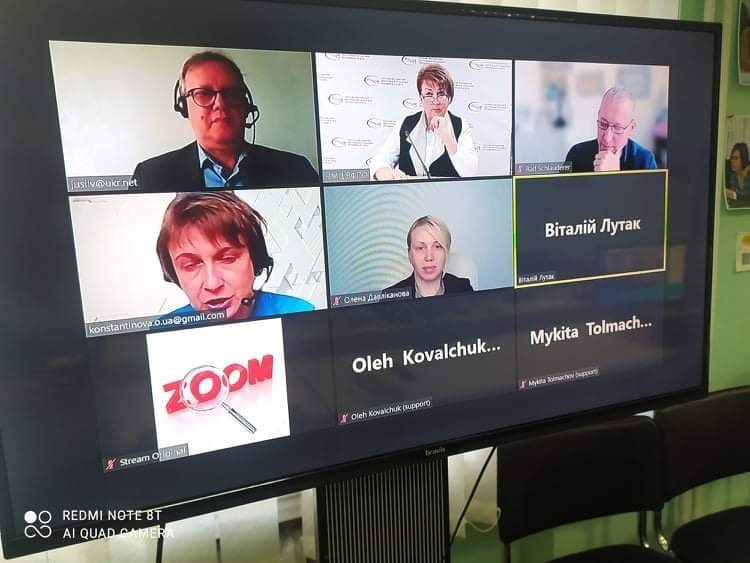
The experience of organising the educational process in the dual form in German universities was presented by Ralf Schlauder, Doctor of Economic Sciences, Professor at Weihenstephan-Triesdorf University of Applied Sciences (Germany).
During his speech, the speaker emphasised that: “Dual education presupposes a constant link between the educational institution and the employer. The employers' interest here lies in the wish to obtain a young, highly qualified employee who is maximally motivated for work immediately after completing studies. He noted that at the university where he works “out of 150 students, 20% study in the dual form”. In particular, the speaker drew attention to how the schedule of the educational process is structured; how curricula are developed; how the work of mentors and consultants is organised; and how ongoing and final assessment of students' learning is carried out. He stressed the need to develop modern curricula and programmes, to train lecturers, and other topical issues. In addition, he dwelt on the advantages, problems and shortcomings of this kind of education. Ralf Schlauder gave practical advice on introducing dual education in Ukrainian educational institutions.
The participants of the event were representatives of educational institutions – participants of the pilot project that train specialists for various sectors of the economy, representatives of partner enterprises and other interested persons, who held a “live” discussion with the speaker in the chat.
The event was informative, substantive and interesting.
Cannot find the information you need?
The admissions office can answer questions about admissions, studying and documents.