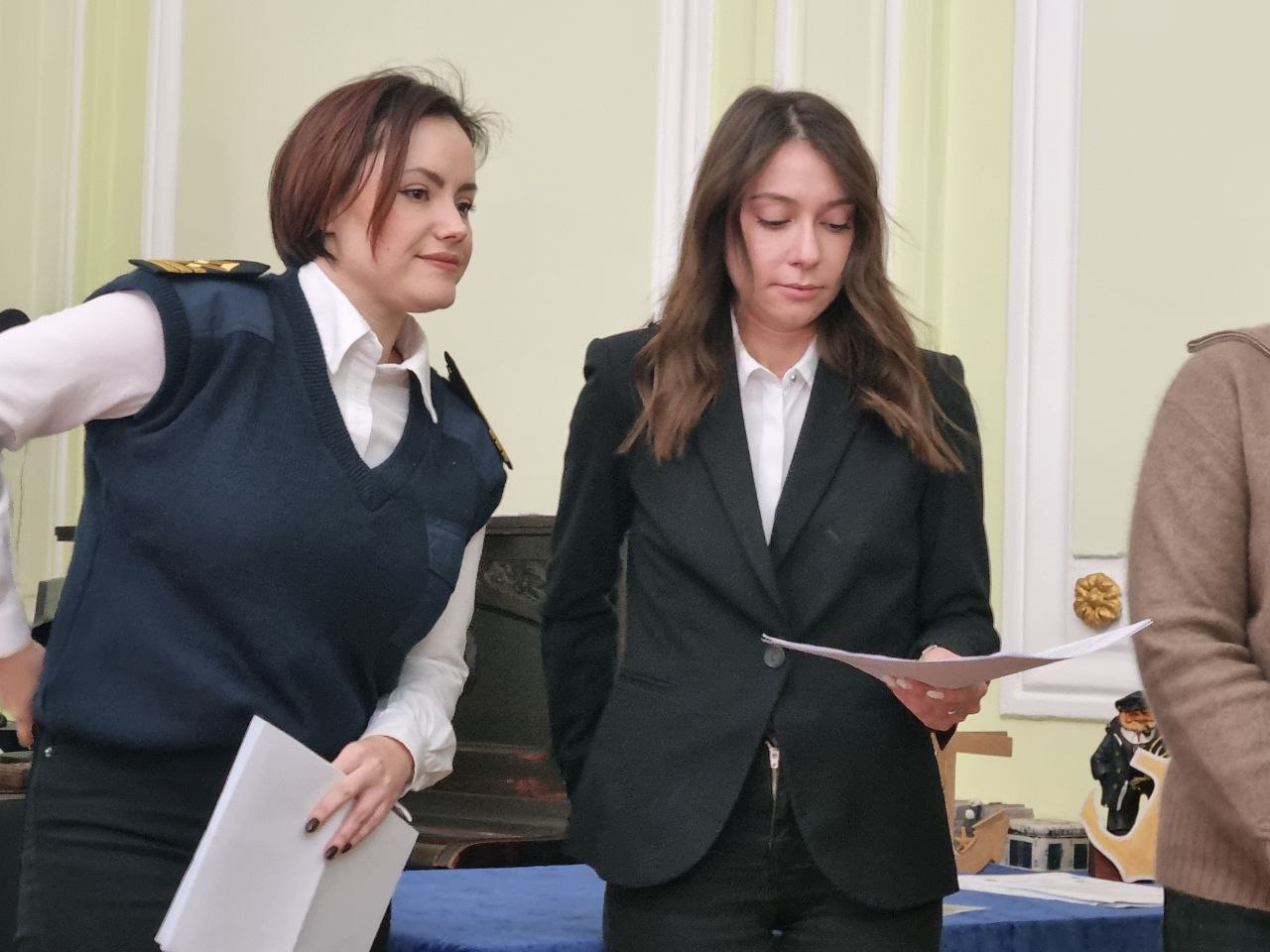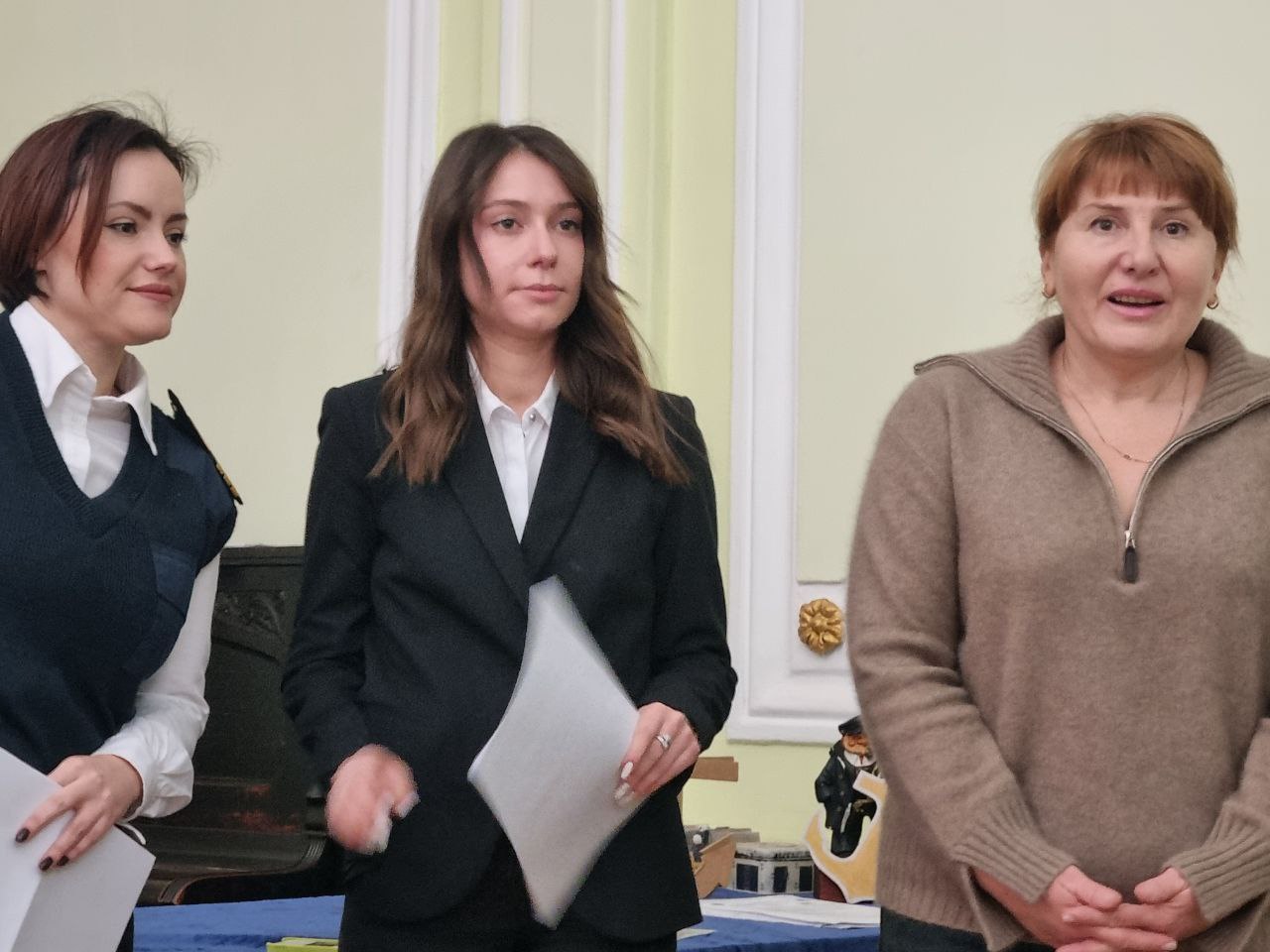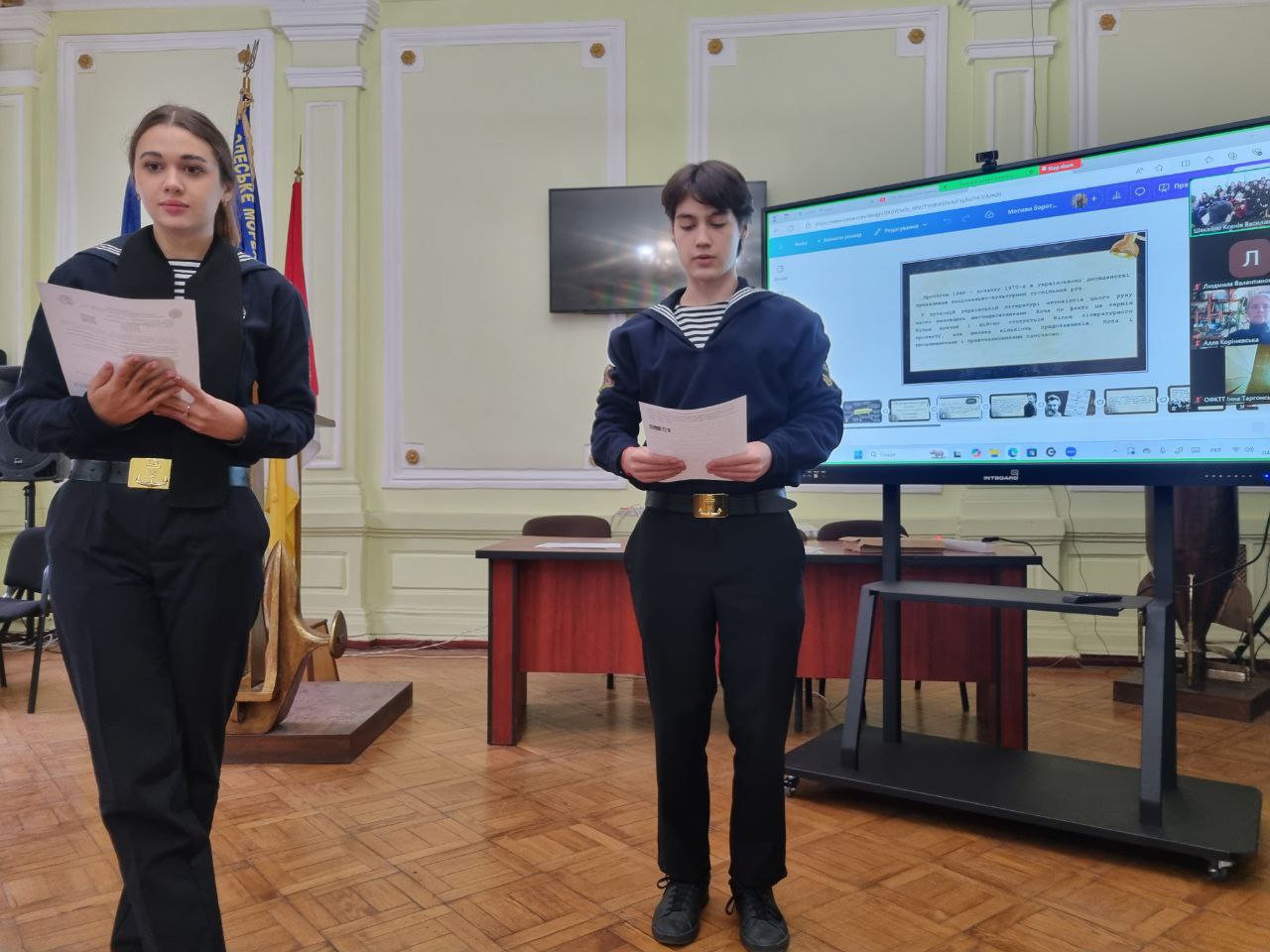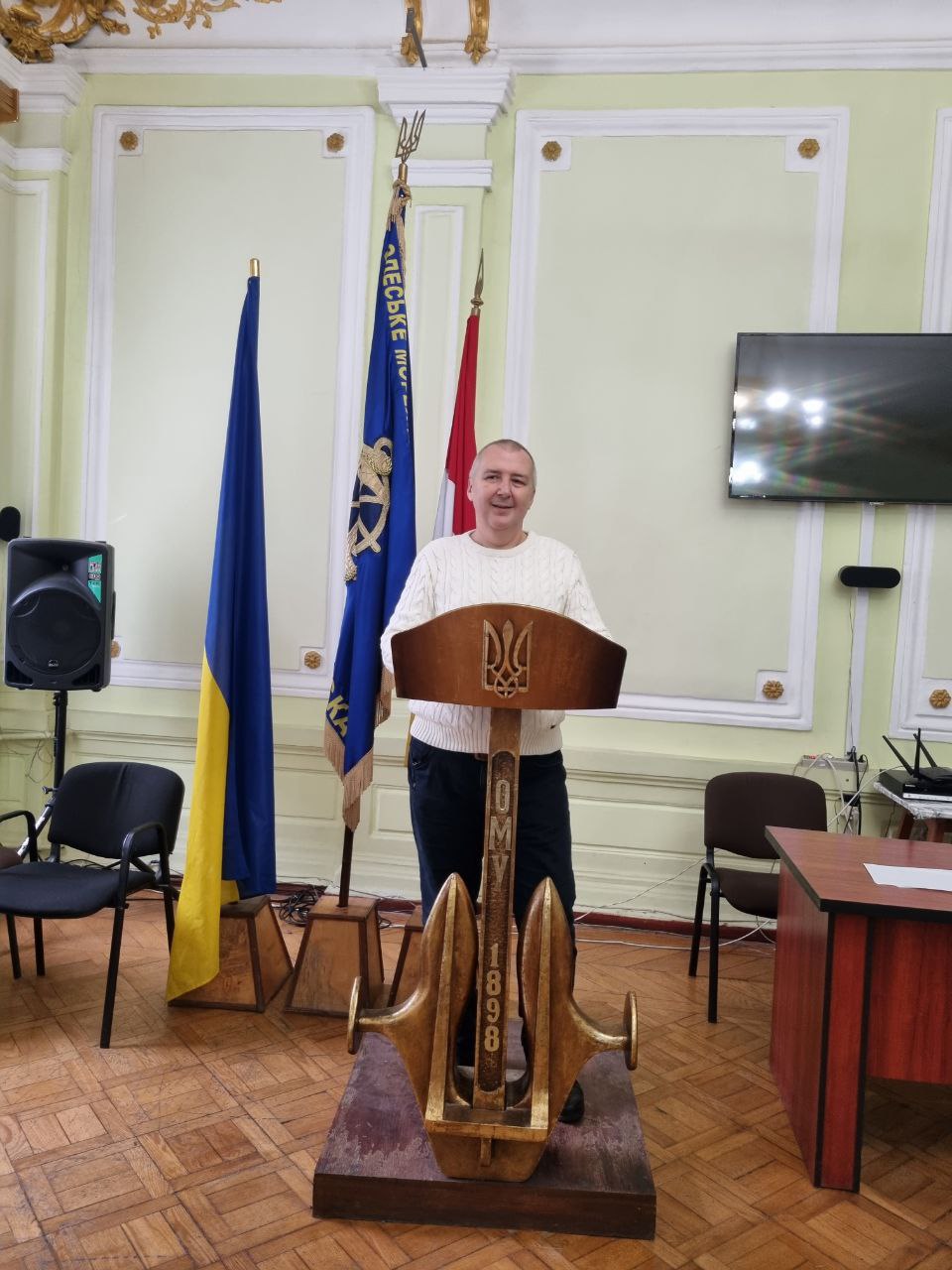

On 4 December 2024, lecturers of the Subject Committee for Social Sciences and Humanities of the SSD “OTPC ONTU” Viktor Myroshnychenko, Maksym Dzhabraiilov, Raisa Spirzhenko and Oleksandr Muravskyi took part in the work of the regional methodological committees of lecturers of history, lecturers of social sciences and law, and lecturers of the Ukrainian language and literature of professional pre-higher education institutions of Odesa Region. The meeting was held at the O.I. Marynesko Maritime Professional College of the National University “Odesa Maritime Academy” in a mixed format: in person in the College's assembly hall and remotely via the ZOOM platform.
The lecturers of history and the Ukrainian language of the O.I. Marynesko Maritime Professional College of the National University “Odesa Maritime Academy” prepared and conducted an open lesson on the topic “Motives of Struggle and Freedom in the Works and Political Positions of Ukrainian Dissidents” and, using interactive equipment, held an educational event at a high level in the presence of the heads of the regional methodological committees of lecturers of history, social sciences and law, and lecturers of the Ukrainian language and literature.
Dissidence grew to a great extent out of de-Stalinisation and the weakening of the “paralysis of fear” that Khrushchev had begun. External factors had a notable influence on the formation of dissent. First of all, this concerns the anti-communist protests, in particular in 1956 in Hungary, then in Poland and East Germany, and the unfolding of the worldwide human rights movement, stimulated by the “Universal Declaration of Human Rights” adopted in 1948 and disseminated in Ukraine from 1963. The moderators of the event emphasised that dissidence was closely connected, first and foremost, with socio-economic tension. As in any group of intellectuals, there was great diversity and difference of views here. Ivan Dziuba, a literary critic and one of the most prominent dissidents, equally sought to obtain both civil liberties and national rights. He clearly expressed his aim: “I propose one single thing: freedom – freedom of honest public discussion of the national question, freedom of national choice, freedom of national self-knowledge and self-development. But first and foremost there must be freedom to discuss and to disagree.” At the beginning, the core of the Ukrainian dissidents consisted of the “Sixtiers” – a new, prolific generation of writers who were gaining recognition. It included Lina Kostenko, Vasyl Symonenko, Ivan Drach, Ivan Svitlychnyi, Yevhen Sverstiuk, Mykola Vinhranovskyi, Alla Horska and Ivan Dziuba. Some were convinced communists. Although the dissidents operated mainly in Kyiv and Lviv, they came from different parts of Ukraine. Most were eastern Ukrainians, but many of them had some ties with Western Ukraine, where they had once studied or worked. There were no more than a thousand active dissidents in Ukraine. The mass repressions of 1972 paralysed the dissidents' activity for some time. Reduced in number but still full of determination, the dissidents received a new impetus in 1975, when the USSR signed the Helsinki Accords and officially agreed to respect the civil rights of its subjects. In November 1976, the Ukrainian Helsinki Group appeared in Kyiv. The Ukrainian Helsinki Group was headed by the writer Mykola Rudenko – a political commissar during the Second World War and a former party official in the writers' organisation. The group had 37 members of the most varied backgrounds. They included dissidents who had already served prison terms, such as Nina Strokata, Vasyl Stus, Levko Lukianenko, Ivan Kandyba, Nadiia Svitlychna and Viacheslav Chornovil; former nationalists such as Sviatoslav Karavanskyi, Oksana Popovych, Oksana Meshko, Iryna Senyk, Petro Sichko, Danylo Shumuk and Yurii Shukhevych; and religious activists such as the Orthodox priest Vasyl Romaniuk. By 1980, approximately three quarters of the members of the Ukrainian Helsinki Group had received prison sentences of 10 to 15 years. The rest were exiled from Ukraine. The activity of the Ukrainian Helsinki Group demonstrated the transition of the dissident movement to a new, more mature stage – a stage marked by an established organisational structure and a clearly defined political programme. The main new element of this programme was the Ukrainian dissidents' transition to positions of independence. The documents of the dissident movement increasingly voiced the demand for Ukraine's withdrawal from the USSR and the creation of an independent democratic Ukrainian state.
At the conclusion of the event, the head of the regional methodological committee of history lecturers, Nadiia Puhachova, emphasised that the dissident movements of the 1960s–1980s were movements whose participants stood for the democratisation of society and for respect for human rights and freedoms, and in Ukraine (the Ukrainian SSR) for the free development of the Ukrainian language and culture and the realisation of the Ukrainian people's right to their own statehood. A characteristic feature of the Ukrainian dissident movement was the struggle for the national interests of the Ukrainian people, which combined the most varied forms of civic protest: from intellectual resistance, expressed both in the writing and distribution through “samvydav” of journalistic, prose and poetic works that exposed the flaws of Soviet society (“Internationalism or Russification?” by I. Dziuba, “The Right to Live” by Yu. Badzo, “The Ethnocide of Ukrainians in the USSR” by S. Khmara, and the journalism of V. Chornovil, V. Moroz, V. Marchenko, Ye. Sverstiuk and others), and in the assertion of unregulated cultural initiatives (the dedicated work of L. Yashchenko, I. Honchar, A. Horska and others in building unofficial museums, libraries and informal associations beyond the control of the authorities), to the creation of organisational structures.